Detect runs of homozygosity using a sliding-window
Source:R/windows_indiv_roh.R
windows_indiv_roh.RdThis function looks for runs of homozygosity in a diploid genome with the
sliding-window algorithm of PLINK 1.9 (--homozyg), with the same
parameters and defaults. It is implemented natively in C++: all individuals
are analysed in a single pass over the genotypes.
Usage
windows_indiv_roh(.x, ...)

# S3 method for class 'gen_tbl'
windows_indiv_roh(
  .x,
  window_snp = 50,
  window_het = 1,
  window_missing = 5,
  window_threshold = 0.05,
  min_snp = 100,
  min_kb = 1000,
  max_kb_per_snp = 50,
  max_gap_kb = 1000,
  max_het = Inf,
  subtract_1_from_lengths = FALSE,
  n_cores = bigstatsr::nb_cores(),
  ...
)
Arguments
- .x
a
gen_tibble, grouped or not- ...
other arguments passed to specific methods. The method for
gen_tibbleobjects uses none: the arguments of the version of this function based ondetectRUNS(e.g.window_size) give an error: usegt_roh_window()for that version.- window_snp
the number of loci in each window (PLINK
--homozyg-window-snp, default 50)- window_het
the largest number of heterozygous genotypes in a window that is a hit (PLINK
--homozyg-window-het, default 1)- window_missing
the largest number of missing genotypes in a window that is a hit (PLINK
--homozyg-window-missing, default 5)- window_threshold
the smallest proportion of the windows that include a locus that must be hits for the locus to be in a run (PLINK
--homozyg-window-threshold, default 0.05)- min_snp
the smallest number of loci in a run (PLINK
--homozyg-snp, default 100)- min_kb
the smallest length of a run, in kb (PLINK
--homozyg-kb, default 1000)- max_kb_per_snp
the largest average distance between the loci of a run, in kb per locus, i.e. the inverse of its smallest density (PLINK
--homozyg-density, default 50)- max_gap_kb
the largest gap between two consecutive loci of a run, in kb: a larger gap breaks a run (PLINK
--homozyg-gap, default 1000)- max_het
the largest number of heterozygous genotypes in a run (PLINK
--homozyg-het, defaultInf, i.e. no limit): a run is broken before the heterozygous genotype that would exceed it- subtract_1_from_lengths
if
TRUE, the length of a run is the distance between its first and last positions; by default it is that distance + 1, as in PLINK 1.9 (PLINK--homozyg subtract-1-from-lengths, which gives the lengths of PLINK 1.07)- n_cores
the number of cores to use (individuals are analysed in parallel)
Value
An indiv_roh object, a tibble with one row per run, ordered by
individual, then by chromosome (in the order of its levels) and
position, with columns:
the grouping variable(s), if the
gen_tibbleis grouped (a singlegroupcolumn for one grouping variable, keeping its type, or one column per grouping variable);id: the individual;chromosome: the chromosome of the run (a factor, with the levels of the loci table; integer chromosomes, fromchromosomes_as_int = TRUE, are replaced by their names from the chromosome sidecar, seegt_lookup_chromosomes(), so the runs are the same as withoutchromosomes_as_int);start,end: the positions of the first and last locus of the run (in bp; PLINKPOS1andPOS2);length_bp:end - start + 1(orend - startwithsubtract_1_from_lengths = TRUE; PLINKKBx 1000);n_loci: the number of loci in the run (PLINKNSNP);first_locus,last_locus: the rows of the first and last locus of the run in the loci table (show_loci());n_het: the number of heterozygous genotypes in the run (PLINKPHETxNSNP);n_missing: the number of missing genotypes in the run.
Its attributes individuals (a tibble of all the individuals, with
their groups, including those with no run), chromosome_length (the
length of each chromosome, its largest position, as in detectRUNS) and
n_loci (the number of loci) are used by autoplot.indiv_roh(),
gt_roh_froh(), gt_roh_loci() and gt_roh_islands().
Details
On each chromosome, a window of window_snp consecutive loci starts at
each locus (except the last window_snp - 1). A window is a hit if it has
at most window_het heterozygous and at most window_missing missing
genotypes. A locus is in a run if at least a proportion window_threshold
(rounded up) of the windows that include it are hits. Runs are stretches of
consecutive loci in a run, which are broken where the gap between two loci
is larger than max_gap_kb, and before the heterozygous genotype that
would exceed max_het. Runs are returned if they have at least min_snp
loci, a length of at least min_kb, and at most max_kb_per_snp kb per
locus.
The runs are those of plink --homozyg with the same parameters,
including the features of its algorithm:
windows restart at each chromosome, so a chromosome with fewer loci than
window_snphas no runs; windows can span large gaps, which only break runs;the number of windows used for the threshold of the last
window_snp - 1loci of a chromosome is the number of loci to its end (which, on chromosomes with fewer than2 * window_snp - 2loci, is more than the number of windows that include the locus);runs are not trimmed, so they can start or end with heterozygous or missing genotypes; missing genotypes in a run are not limited.
Genotypes are classified by their dosage (1 is heterozygous, 0 and 2 are
homozygous). Unlike PLINK, all chromosomes are analysed: PLINK skips
haploid chromosomes (e.g. Y and MT), and male X chromosomes. Remove them
first (e.g. with select_loci()) to get the same runs. PLINK has no
runs of heterozygosity; gt_roh_window() (based on detectRUNS) can
still find them. The loci must be sorted by chromosome and position (see
gt_order_loci()).
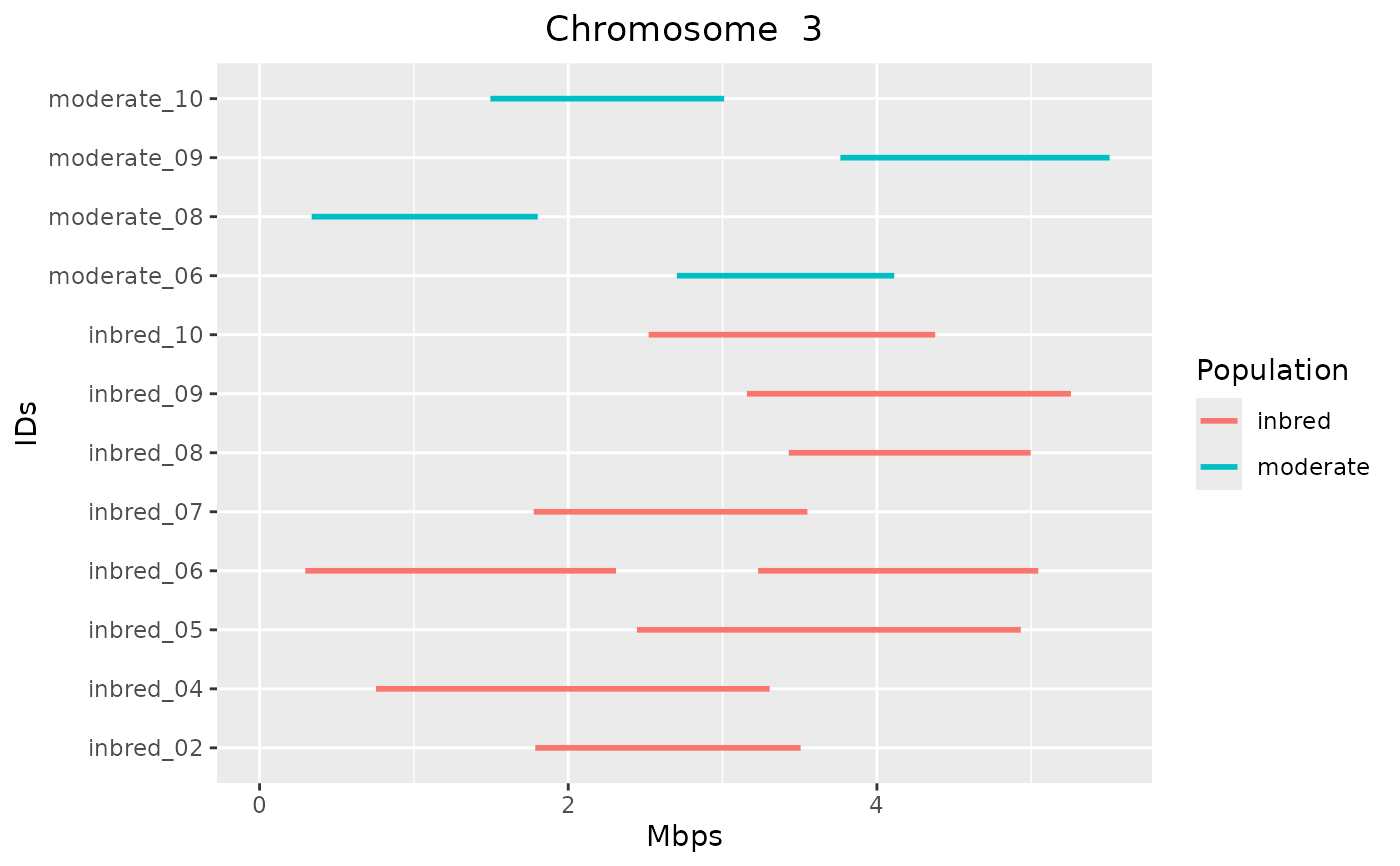
Runs can be plotted with autoplot.indiv_roh(), which draws the plots
of detectRUNS. Use as_detectRUNS() to convert the runs to the format
of detectRUNS, to use its own functions.
windows_indiv_roh() is an S3 generic, with a method for gen_tibble
objects (grouped or not). Other packages can add methods for their own
classes (e.g. tibbles of genotype likelihoods).
References
Chang CC, Chow CC, Tellier LCAM, Vattikuti S, Purcell SM, Lee JJ (2015) Second-generation PLINK: rising to the challenge of larger and richer datasets. GigaScience, 4. doi:10.1186/s13742-015-0047-8
Examples
# a simulated dataset of three populations with increasing inbreeding
# (see data-raw/create_roh_dataset.R in the source of the package)
bed_file <- system.file("extdata", "roh", "roh_sim.bed",
package = "tidypopgen"
)
sim_gt <- gen_tibble(bed_file, backingfile = tempfile(), quiet = TRUE)
sim_gt <- sim_gt %>% group_by(population)
sim_roh <- windows_indiv_roh(sim_gt)
sim_roh
#> # A tibble: 36 × 11
#> group id chromosome start end length_bp n_loci first_locus last_locus
#> * <chr> <chr> <fct> <int> <int> <int> <int> <int> <int>
#> 1 moder… mode… 1 6.22e6 8.46e6 2240031 242 606 847
#> 2 moder… mode… 2 4.99e6 6.27e6 1278671 181 1568 1748
#> 3 moder… mode… 1 2.36e6 4.53e6 2178354 217 227 443
#> 4 moder… mode… 1 1.24e6 4.16e6 2915333 293 113 405
#> 5 moder… mode… 2 5.85e6 7.39e6 1546032 240 1682 1921
#> 6 moder… mode… 3 2.70e6 4.11e6 1408627 238 2456 2693
#> 7 moder… mode… 2 1.10e6 2.49e6 1392978 215 1152 1366
#> 8 moder… mode… 3 3.38e5 1.80e6 1464842 226 2077 2302
#> 9 moder… mode… 3 3.76e6 5.51e6 1744833 279 2641 2919
#> 10 moder… mode… 3 1.50e6 3.01e6 1514616 275 2244 2518
#> # ℹ 26 more rows
#> # ℹ 2 more variables: n_het <int>, n_missing <int>
# the number of runs in each population
table(sim_roh$group)
#>
#> inbred moderate
#> 26 10
# \donttest{
# use the plots of detectRUNS
if (rlang::is_installed("detectRUNS")) {
detectRUNS::plot_Runs(runs = as_detectRUNS(sim_roh))
}
#> Warning: Using `size` aesthetic for lines was deprecated in ggplot2 3.4.0.
#> ℹ Please use `linewidth` instead.
#> ℹ The deprecated feature was likely used in the detectRUNS package.
#> Please report the issue at
#> <https://github.com/bioinformatics-ptp/detectRUNS/issues>.


 # }