Convert an object created with blockCV to an rsample object
Source: R/blockcv2rsample.R
blockcv2rsample.RdThis function converts objects created with blockCV to rsample objects
that can be used by tidysdm. BlockCV provides more sophisticated sampling
options than the spatialsample library. For example, it is possible to
stratify the sampling to ensure that presences and absences are evenly
distributed among the folds (see the example below).
Details
Note that currently only objects of type cv_spatial, cv_cluster,
cv_nndm and cv_buffer are supported. The latter two are one-out-cross
validation methods, so the resulting rsample object will have n splits,
where n is the number of folds in the original blockCV object (which can
be very large!).
Examples
library(blockCV)
points <- read.csv(system.file("extdata/", "species.csv",
package = "blockCV"
))
pa_data <- sf::st_as_sf(points, coords = c("x", "y"), crs = 7845)
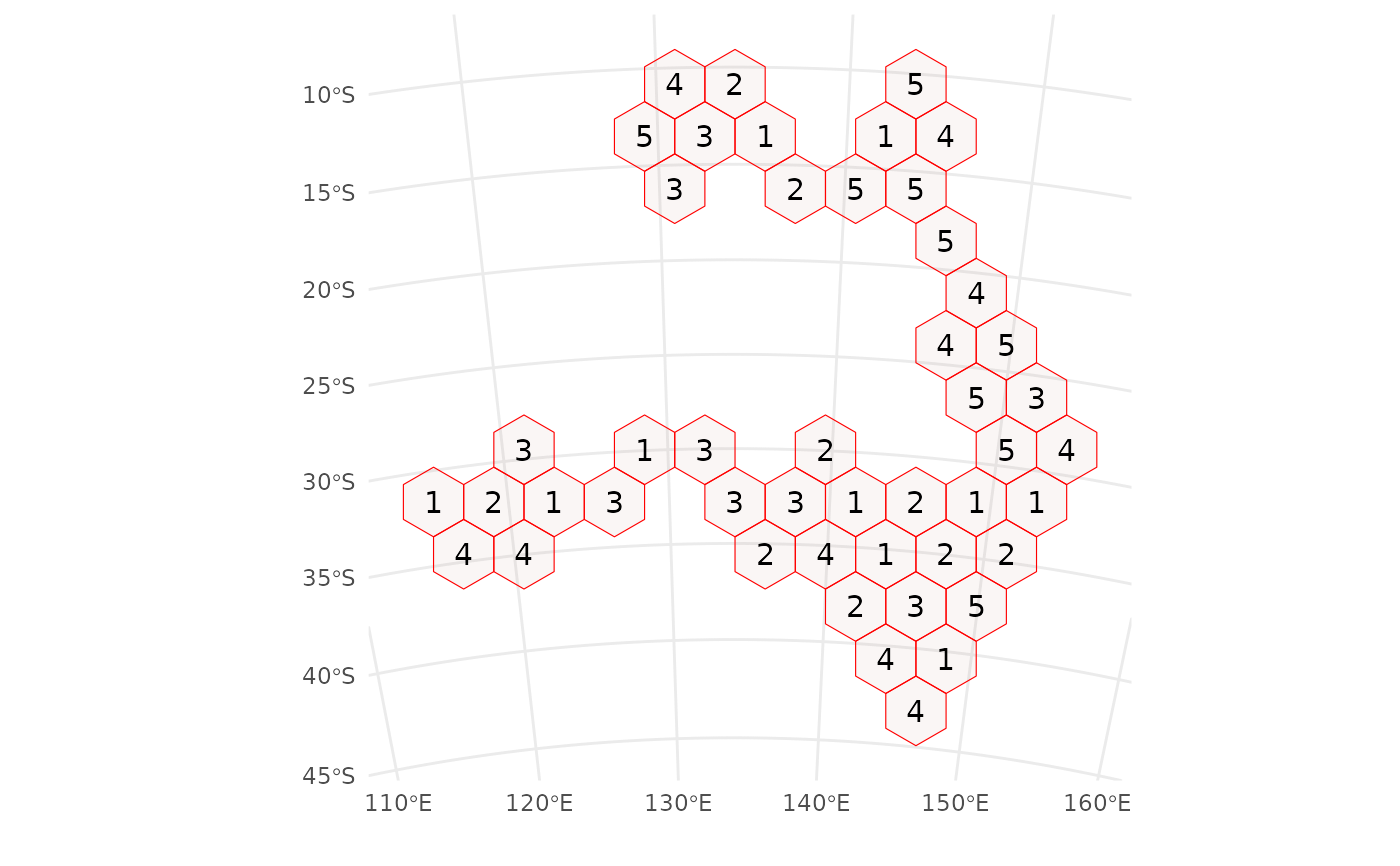
sb1 <- cv_spatial(
x = pa_data,
column = "occ", # the response column to balance the folds
k = 5, # number of folds
size = 350000, # size of the blocks in metres
selection = "random", # random blocks-to-fold
iteration = 10
)
#>
|
| | 0%
|
|======= | 10%
|
|============== | 20%
|
|===================== | 30%
|
|============================ | 40%
|
|=================================== | 50%
|
|========================================== | 60%
|
|================================================= | 70%
|
|======================================================== | 80%
|
|=============================================================== | 90%
|
|======================================================================| 100%
#> train_0 train_1 test_0 test_1
#> 1 209 183 48 60
#> 2 216 175 41 68
#> 3 198 195 59 48
#> 4 188 212 69 31
#> 5 217 207 40 36
 sb1_rsample <- blockcv2rsample(sb1, pa_data)
class(sb1_rsample)
#> [1] "cv_spatial" "spatial_rset" "rset" "tbl_df" "tbl"
#> [6] "data.frame"
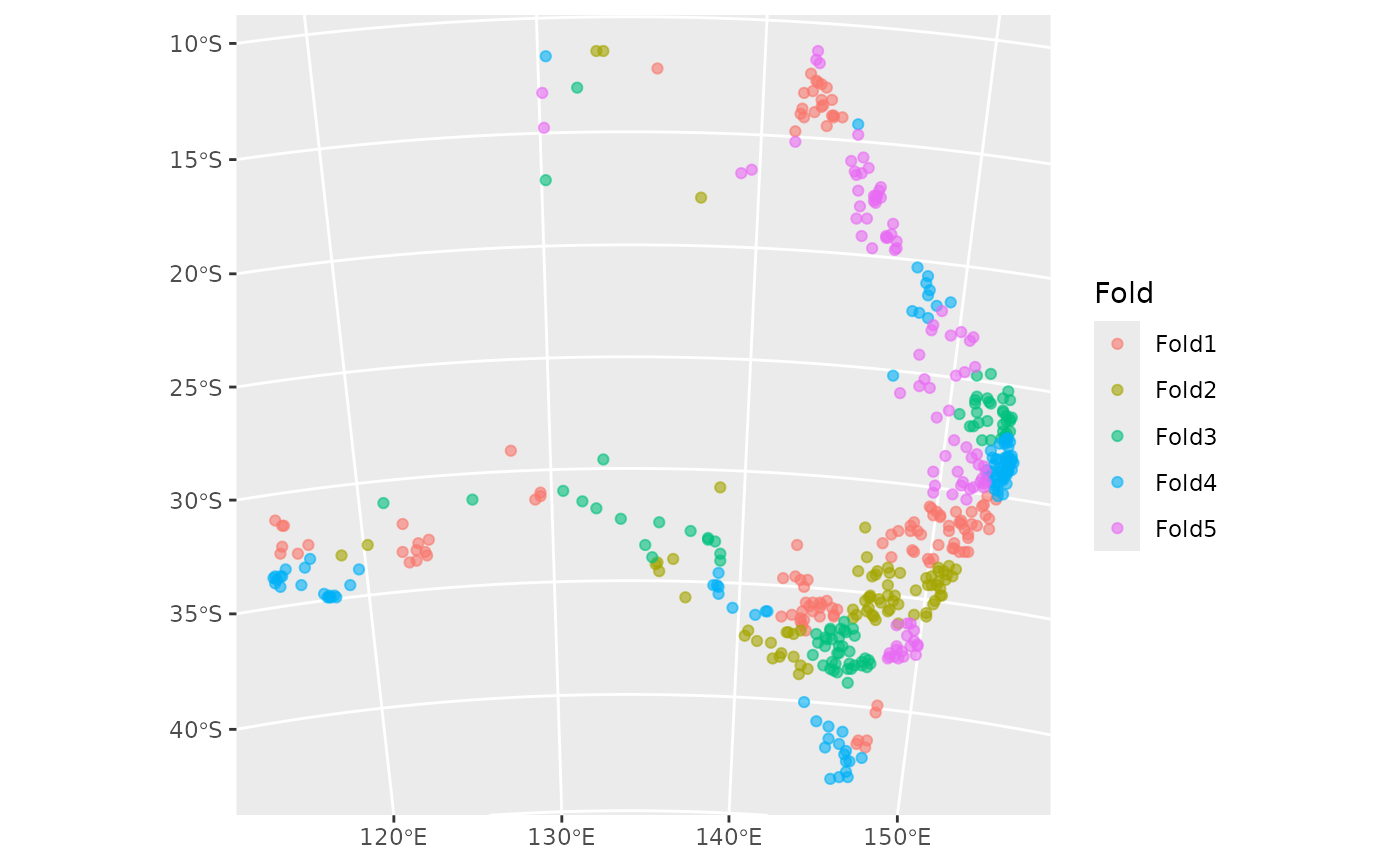
autoplot(sb1_rsample)
sb1_rsample <- blockcv2rsample(sb1, pa_data)
class(sb1_rsample)
#> [1] "cv_spatial" "spatial_rset" "rset" "tbl_df" "tbl"
#> [6] "data.frame"
autoplot(sb1_rsample)